How it all started...
What inspired you to start making overlay pens? The first O/lay that I made was actually a repair, to a 1920's Watermans 56, and at sometime in it's life it must have suffered an accident, which left it with only the cap O/lay intact, but the barrel was missing it's silver covering, I made a tracing-paper copy of the cap design, and went along to a jeweller friend of mine, and asked him if we could make an O/lay for the barrel of the pen.He told me all number of reasons why it would not be possible, but I was persistent, and eventually we produced a fairly acceptable copy of the original silver decoration. During this process, I learned what was to become the grounding for creating my overlaid fountain pens.
What was your first overlay design and when was it produced? I had always liked Conklin Crescent-filler fountain pens, and despite the added complication of having to make 3 parts to the completed pen I started producing O/lays for original Conklin pens, and selling them from my stand at Portobello Market on Saturdays. By June 1998, 'The Battersea Pen Home' had shown an interest in these 're-creation' pens, and decided that they would like to commission me to make some for them. Within a very short time they were selling them faster than I could produce them. Altogether, I did about 20 for them.
Where do you look for inspiration? My inspiration can come from almost anywhere, old biscuit tins, old adverts, theatre program covers, but more recently, I have invested in books about different artists, and have copied designs from these sources. My favourite artist is without a doubt, Alphonse Mucha, his ladies are so beautiful, and is considered by most to be the epitome of the Art Nouveau Period.
What are the steps you take to make an overlay (from design idea to completion)? When it comes to the different stages of making O/lays from design to completion, I use [on a background of graph-paper to insure that the corners are square] tracing paper, the graph-paper also helps to ensure that the edges are in line to meet up exactly, when the flat metal is curled into a cylinder. Once the design is drawn, I transfer it to the silver or gold sheet of metal, then pierce out the pattern, then the engraving has to be done. The next stage is to curl the sheet into a cylinder round a steel mandril, I have to use a leather mallet to do this, and it is sometimes very worrying if the design is very intricate, as a mistake at this stage can mean starting again from scratch! Once the cylinders have been soldered, they are filed with a flat file to tidy-up the joins. The Overlays are then burnished, and are sent down to have the base-pens made. The Assay Hall Marks are put on at this stage.
On average, how long does it take for you to make an overlay design on paper? How long is a piece of string? I have been known to scribble an idea onto a pice of paper, and straight away I have created the next design for a pen, but that doesn't happen very often! In the cases of commissioned 'bespoke' designed' pens, it sometimes takes weeks or even months to get everything right for the client, I am working on a design at the moment which has been on-going for the past 6 months, it is a spiral design, with a prayer inscribed [in Arabic script], a language that I am not familiar with, an expert calligrapher had to be brought in to advise me regarding the script!
Can you create overlay pens to incorporate precious stones (diamonds, rubies, birthstones, etc)? Other than the Snake pattern Pen, I have not used precious stones in my pens, but if I was asked to, I would oblige, although stone-setting is not one of my talents, therefore I would have to ask one of my friends up at Hatton Garden to do the setting for me.
About how many overlays have you made and which designs mean the most to you and why? I honestly do not know how many different designs I have done, but it must be more than fifty, but in terms of the total number of pens that are in existence, it must be several hundred, as the Conway Stewart commissioned pieces must be a few hundred on their own. Without a doubt the ones that have meant the most to me have been the 'bespoke designs', the most recent of these was the 'Violin Pen' which I did for a gentleman who has been following my overlaid pens since the very start, and he has got a collection of every design that I have done so far, I put my heart and soul into making it for him, he is a very special friend to me.
What is the most unique overlay design you have created? Why was it unusual? The 'Spirit Of Life' pen which I am still working on, has definately taken longer than any other to make, there are several reasons for this, firstly, spirals are very difficult to do,[there is very little room for error] also the script had to be done in a language that I am not familiar with [which meant that I had to engrave it 'blind', from the script that the calligrapher sent me], it was with enormous relief when he told me that I had got it right after he had seen and checked it!
Why choose Conway Stewart as the base pen for your overlay designs? I had known the previous owner of Conway Stewart for quite a long time, and had helped him by giving him examples of the different clips from vintage C/S pens which he then had reproduced for producing the classic models that the new pens use. Having then had the opportunity to design the first commission for the Centenary Pen in 2005, it seemed the logical next step to have the pens made by them, apart from the fact that they are the only truly British pen manufacturer in the UK. I am in a totally unique situation really, as they are quite prepared to make a 'one-off' pen to fit my cap and barrel overlay for one of my 'bespoke' pens. It is a mutual affiliation between us, I greatly appreciate the association with Conway Stewart, as I hope they enjoy being connected with my overlaid pens.
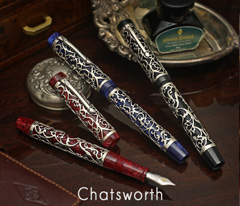
What inspired you to make the Conway Stewart Centenary Overlay? How difficult was it to produce the design incorporating the ‘C’ and ‘S’ and ‘1905’? I knew that the time was approaching [in 2004] to do a centenary pen for C/S, and I just went ahead and showed the design to them, and they liked it, the rest is history as they say, it was quickly followed by the 'Henry Simpole' pen, which sold very quickly, then the Exhibition 'Giant' Pen was commissioned, then the Chatsworth was the last one. As I have already said, it has turned out to be a successful association really.
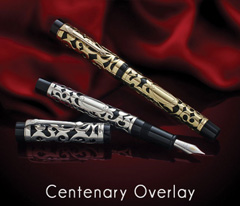
What inspired you to design the ‘Simpole’ Pen? How long did it take from the initial design conception through to completion? The Simpole Pen took a comparatively long time to do, [I suppose about six months from the time of approval of the design to completion of the O/lays.] but due to the intricate design, there were a lot of 'miscasts' which means delays in production, but we got there in the end. It was obviously worth the extra effort, because it sold out fairly quickly.
Is the Great Exhibition the largest overlay you have made on a working pen? Was it fun to create an over-size overlay? Yes it is without a doubt the biggest O/lay I have done to date, the most time consuming part of the pen O/lay was the subliminal CS which is 'hidden' in the cap design, the difficulty being to balance the letters with the 'foliate' pattern surrounding them. It is very difficult to get it right, whereby the letters are apparent when they are 'pointed out' but are hidden and unobtrusive at first glance. The reason that I have tried to incorporate the initials in all the Conway Stewart commissioned pieces is to give an 'intrinsic value' to the designs. Of coarse with the Chatsworth, I went one step further, and put the extra J and G in the design, to represent Jarvis and Garner, the two gentlemen who started the company in 1905.
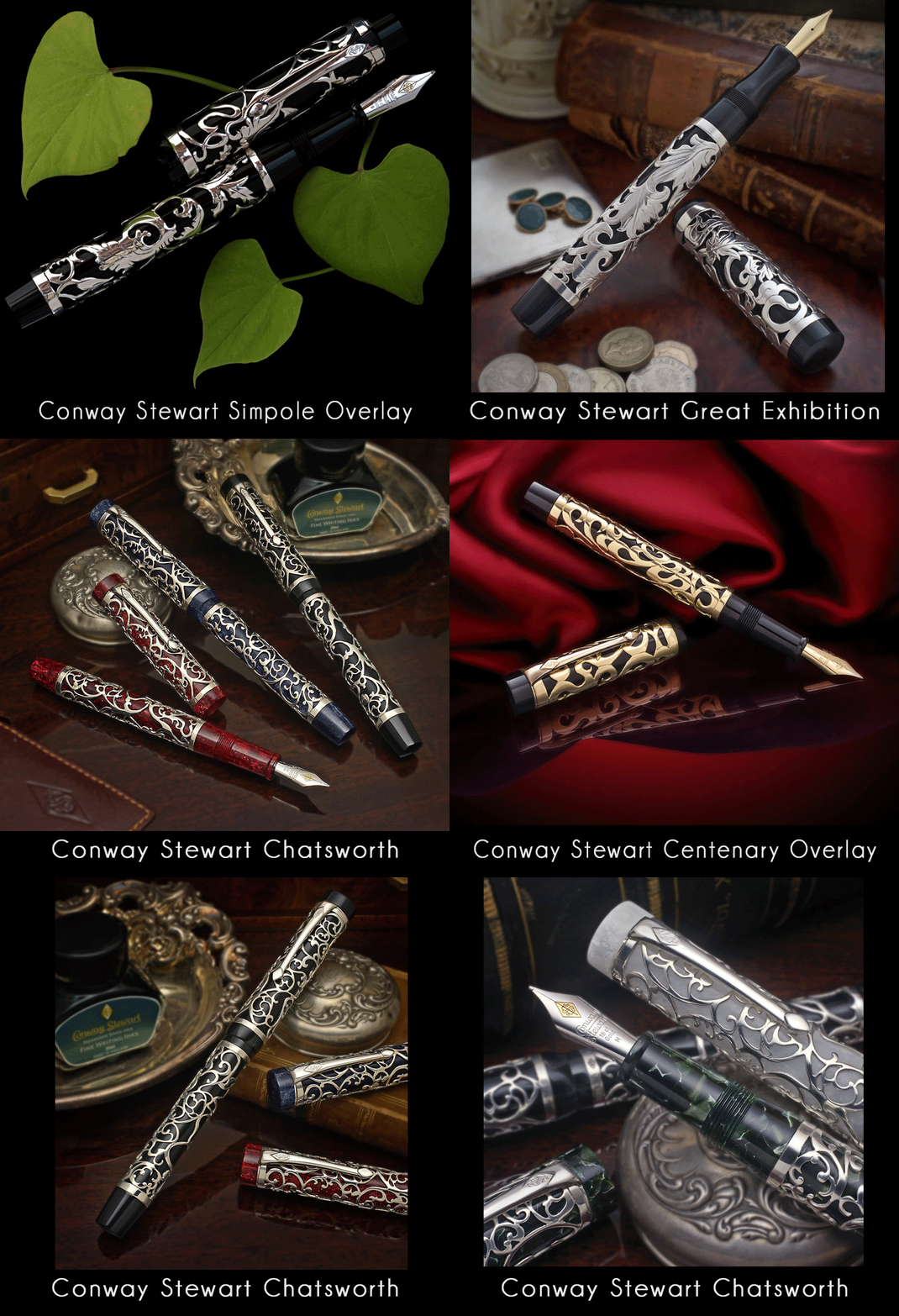
What makes the Chatsworth overlay different to the previous designs you have created for Conway Stewart? The Chatsworth Pen is definately the most delicate filligree pattern to date on any of the commissioned pieces.To give you an idea, about 20% of the cap O/lays were sent back for re-casting, it is because the flow of the molten metal is restricted through the fineness of the design. I personally think that it was worth the effort, I am very proud of that particular design, but I doubt if such a fine filligree design will ever be attempted by me or anyone else, not for large numbers anyway.
Where did you draw your inspiration for the Chatsworth design? ? The inspiration for the design of the Chatsworth Pen came from a book that I have called Typographical Ornaments, and I picked out various patterns and joined them up to what I think is a very pretty overlay, the main aim on my part was to produce as delicate a design as possible, I think that I achieved that.
Did the Chatsworth design take longer to create and complete? If so, why? The Chatsworth pen did take longer to do than the other overlays, mainly because of the problems with the casting, but one has to be more careful with the 'finishing' of the O/lays, due to their fragility. It was because of the challenge that I was prepared to go the extra mile. It is my personal favourite of the four C/S overlays.
Apart from the Conway Stewart Chatsworth and Great Exhibition overlay pens that are readily available to purchase today, what is the current time frame of your waiting list? At the moment, my bespoke pen waiting list is about 6 or 8 weeks, before I start to produce the drawings for a design. How long before the O/lays are ready depends entirely on the complexity of that design.
Henry Simpole
United Kingdom